Tampilkan postingan dengan label history. Tampilkan semua postingan

Rabu, 19 Januari 2011

Dogs Were Man's Best Friend Even 9,400 Years Ago

PORTLAND, Maine -- Nearly 10,000 years ago, man's best friend provided protection and companionship - and an occasional meal.

That's what researchers are saying after finding a bone fragment from what they are calling the earliest confirmed domesticated dog in the Americas.

University of Maine graduate student Samuel Belknap III came across the fragment while analyzing a dried-out sample of human waste unearthed in southwest Texas in the 1970s. A carbon-dating test put the age of the bone at 9,400 years, and a DNA analysis confirmed it came from a dog - not a wolf, coyote or fox, Belknap said.

Because it was found deep inside a pile of human excrement and was the characteristic orange-brown color that bone turns when it has passed through the digestive tract, the fragment provides the earliest direct evidence that dogs - besides being used for company, security and hunting - were eaten by humans and may even have been bred as a food source, he said.

Source

Jumat, 09 Oktober 2009

an unlucky kitten finds a good person

I've been reading Robert Roberts' A Ragged Schooling: Growing Up in the Classic Slum (New edition: Mandolin, 1997). This autobiography of a childhood spent in the poorest districts of Salford, UK during the Edwardian era is gripping, sympathetic, and by some alchemy of Roberts' character and talent, only sad in the shadows. But even many of his grimmer childhood observations and experiences are warmed by the care of the truly great figure at the center of the tale: his mother. A shopkeeper, well read, mother to 7 children (and frankly as well to a charming, alcoholic husband), she calmly kept to her own home. Yet every so often the ugliness beyond would intrude, and she would always have an answer.

One day she even had an answer for a kitten in a bad way, brought to young Robert by a schoolfellow (you'll find this story on p. 83):

Once, in a narrow entry that ran behind the street, Iggy wandered up to me with a black, snake-like object that jerked stiffly on his hands, then lay still, staring. I stepped back, afraid.
"It's a kitten," he said. "Some rotten pig's rolled it in hot pitch off the road! Now it's gone hard."
"What - What can we do?" I asked.
"Your old lady," he said, "she's the one." (Ignatius, for some reason, held my mother in awe and always assumed I feared her too.) He came with me to the entry end and I took it in at the back door. Face set, Mother examined the dreadful offering. "Put it down," she ordered at last. Then, going into the shop, she scooped up a lump of lard and dropped it into the frying pan. Soon we were kneading warm oil into the kitten's fur, after which she washed it with soap and water.
"How's the moggie?" Ignatius asked later.
"Like a lump of wool now!" I told him. "We're going to keep it," which seemed to please him.

Senin, 28 September 2009

more medieval cats on pages

As you probably have figured out by now I do love a sprightly manuscript detail. Turns out the Getty Museum has one I've missed. From England, about mid 13th century, a couple of white cats go after brown mice, with mixed results - or perhaps it's a comic book-style telling of a cat's failed bid to hang on to mousie, as it shows up immediately underneath in its own vignette looking perky and even triumphant. I'm particularly impressed with the skilled elegance with which the cats are drawn, not a line wasted.

Of course copyright forbids my posting the image, but I'll send you right to it here.

Jumat, 20 Maret 2009

You learn something new every day

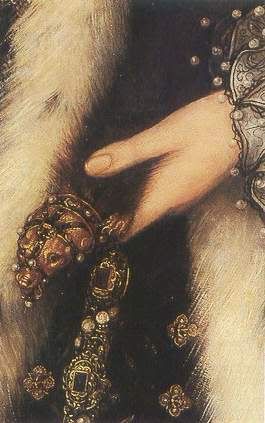
This is a Zibellini, or Flea Fur

Zibellinis were a popular accessory item for noble men & ladies during the 15th and 16th centuries. A zibellino, from the Italian word for "sable", is the pelt of a sable or marten worn draped at the neck or hanging at the waist, or carried in the hand. The plural is zibellini.

Some zibellini were fitted with faces and paws of goldsmith's work with jeweled eyes and pearl earrings, while unadorned furs were also fashionable.

The traditional costume historian's term for this accessory, flea-fur, is from the German Flohpelz, coined by Wendelin Boeheim in 1894, who was the first to suggest that the furs were intended to attract fleas away from the body of the wearer. There is no historical evidence to support this unlikely claim. Italians simply called these accessories "zibellini", their word for sables, and speakers of other languages called them "martens", "sables" or "ermines" in their native tongues.

Zibellini was the entire pelt of an animal, usually marten or sable, but also ermine and lynx were used, and was carried in the hand, over the shoulder or around the neck, and was suspended from a gold chain attached to a girdle. The head and feet of which were often bejewelled replacements for the animals original body parts. There are accounts of clocks being set into the heads. Gold and silver were the norm for the head and feet of the Zibellini, but crystal and jet were also used. Zibellini were further embellished with diamonds, rubies, pearls and enamel work.

The fashion for carrying zibellini died out in the first years of the 17th century, although fox-pelts were worn in similar fashion in the 19th and 20th century. [wiki]

(via Scribal Terror)